

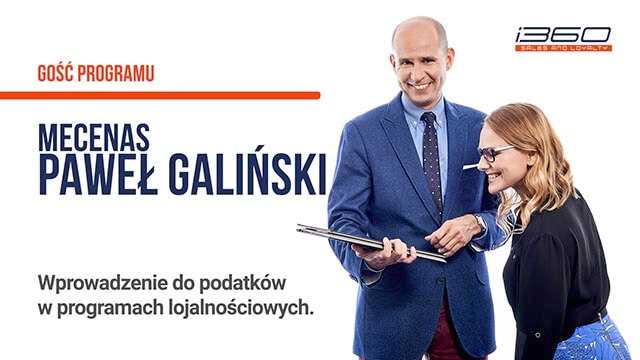
Transcript of the episode: https://www.youtube.com/watch?v=IEKev386dac
KN: On loyalty schemes at night. Katarzyna Nawrocka here. I’d like to introduce our guest. First of all, thank you very much for agreeing to take part in our programme. Mr Paweł Galiński, barrister.
PG: Thank you very much for inviting me. I’m delighted to meet you and share our knowledge of taxation.
KN: I’m also very much looking forward to speaking with you, and I’d like to ask you straight away, as an expert, to explain what we’ll be discussing today.
PG: Today we’ll be discussing the key fundamental aspects of planning promotional campaigns for loyalty schemes. We’ll be discussing the basic tax issues involved in organising this type of loyalty programme – in other words, what every business owner interested in such programmes should bear in mind.
KN: Mr Lawyer, let’s start by discussing the development of the concept for any professional loyalty scheme. It is necessary to define the tax model under which it will operate. What does this term mean?
PG: By this term, we should mean the entire spectrum of elements that make up the tax model of a loyalty scheme. Undoubtedly, right at the outset, anyone interested in this type of programme should consider and define very precisely who the programme is intended for, because the target audience has a very significant impact on the tax treatment of the rewards to be issued; consequently, we distinguish between consumers as recipients – that is, the so-called B2C models. The second model involves business-to-business transactions, that is, effectively between two businesses, whilst the third model comprises programmes aimed at employees, to put it very briefly. The tax model must, in fact, provide for at least three elements. One of these elements is the method of transferring the cost of the programme from the loyalty scheme organiser to the sponsor. As a point of note, we’ll always refer to the sponsor as the business that bears the financial cost of organising the loyalty scheme, right? That’s a bit of a shorthand here. The second element we must always take into account is the method of documenting the awarding of rewards during the loyalty programme. This issue is also very important, as the right approach ensures that our actions comply with current tax legislation. And the third element is that we must verify very carefully and subject to a very detailed analysis what the tax consequences will be associated with the act of awarding specific rewards to the winners of loyalty programmes. When considering how to organise a given loyalty programme, we must also think very carefully about whether any tax risks will arise during the programme’s implementation, as the modern economy is characterised by a very high degree of diversity.
KN: There are a lot of variables.
PG: There are a great many variables, exactly. The days when entrepreneurs operated according to so-called ‘standard formulas’ are long gone, yes, and in reality they are simply replicating models used several decades ago. Well, as we know, we actually live in a knowledge-based economy, a competitive economy, which means that individual businesses are constantly competing with one another, seeking new solutions, better solutions – ones that simply give them a so-called market advantage. This has a very significant impact on the design of loyalty programmes, and it also means that we very rarely encounter a situation where one loyalty programme is identical to that run by our direct or even indirect competitor.
KN: We want to stand out; we want to be more customer-friendly.
PG: Yes, yes. When fighting for their share of the market– perhaps it’s a bit of a hackneyed phrase, but in reality, entrepreneurs focus on innovation; in other words, on always staying one step ahead of the competition, on coming up with something new, on surprising the consumer, on surprising their client, on surprising their audience. Of course, the fact that we’re constantly seeking these innovations means that programmes become more complex; as I mentioned, programmes are rarely identical, and whilst this creates opportunities in the market, it also poses risks. This means that we must always verify in great detail how to determine these tax consequences. In this regard, what room for manoeuvre do we have in such a situation, what solutions are available to us, and what legal instruments do we have to mitigate and limit the risks associated with carrying out this type of activity?.
KN: But our aim is to take steps in good time to ensure that these consequences do not arise.
PG: So that these consequences do arise, but so that they are calculated, so that we actually know what tax consequences we will face when implementing a given loyalty scheme: who is liable to pay the tax, the amount involved, the rate applicable, and the deadline. What tax returns or information, if any, need to be prepared; to whom they should be sent; and what their content should be. These are, in fact, the key issues, and the question is: what tool do we have to mitigate this risk? That tool is individual tax rulings. This means that any business owner wishing to minimise the tax risk associated with organising loyalty schemes may apply to the Director of the National Tax Information Service, requesting that this tax authority set out its position on what the tax consequences will be if a given loyalty programme is implemented. This is a very useful legal instrument. It is a legal instrument which, in my view, is widely used by all professional marketing agencies that assist businesses in organising such programmes.
KN: Or it should simply be used.
PG: Exactly. However, submitting such an application usually requires the business owner to consult a professional – in other words, a specialist law firm or marketing agency – which possesses the necessary „know-how” to prepare this type of application correctly, because only a correctly prepared application, with the right questions asked regarding a clearly defined set of facts, can guarantee that the response from the tax authority will, above all, be specific, precise and provide us with very clear guidance on how we should proceed. This is very important, as the tax authorities take a rather formalistic approach to such applications. They expect a very high level of precision from entities applying for this type of interpretation; consequently, the assistance of a professional adviser at this stage is generally essential.
KN: Mr Lawyer, as we know, the financial burden of running a loyalty scheme is borne by the entity that commissions it, that is, the sponsor.
PG: Yes, exactly.
KN: In most cases, the client – that is, the sponsor – does not run the programme on their own, but enlists the help of professionals. In return for a fee, of course. And this party, this professional, is known as the organiser.
PG: Yes, exactly.
KN: How do the settlement models used in Poland between the organiser of a loyalty scheme and its sponsor work in practice?.
PG: In Poland, we use two basic tax models for the accounting treatment of loyalty schemes. Firstly, I would like to discuss the most popular tax model, as it is used by the vast majority of organisers. It is based on the well-known 2010 ruling of the Court of Justice of the European Union in the Baxi Group case. This is a tax model which assumes that the organiser provides a marketing service to the client, and the client is the recipient of that marketing service; in addition, the organiser also supplies goods in the form of rewards to that client. The adoption of this tax model has very specific consequences under tax law, in particular under the VAT Act. This means that the organiser is obliged to charge the client for the cost of running the programme, and the cost of the programme comprises the cost of the marketing service and the cost of the prizes awarded. Consequently, the organiser generally issues two VAT invoices to the sponsor: one for the so-called net value of the marketing service, and the other for the value of the prizes awarded under the programme. However, as regards the value of cash prizes and so-called SPV vouchers, the cost of these prizes is transferred from the organiser to the client via a debit note, as in this case no VAT is payable. The question naturally arises as to the main principles on which this ruling in the Baxi Group case was based. In that ruling, the Court of Justice of the European Union held that if a principal commissions an organiser to run a loyalty scheme, and terms and conditions are drawn up under which prizes are awarded to participants, then de facto we are dealing with a legal arrangement whereby the principal bears the financial cost of the entire loyalty scheme, including the prizes, and de facto, it is the principal who is the purchaser of these rewards and, consequently, should be charged the cost of these rewards on the basis of a VAT invoice. However, the terms and conditions of the programme stipulate that it is at the principal’s discretion that the reward is issued directly to the participant in the loyalty programme without the principal’s physical involvement in the process. The consequence of this is that the only evidence a loyalty programme participant receives in connection with the award of the prize is, as a rule, a handover report. As I mentioned, this first model discussed is the most common. It is used by most marketing agencies operating in Poland, and it is precisely this model that the tax authorities generally favour, following the aforementioned 2010 ruling in the Baxi Group case.
KN: But you mentioned that we have two models, so perhaps we could talk about the other one as well.
PG: Yes, there is also a second model, which is much less common, but one does come across it from time to time. This model assumes that the marketing service is actually provided by the sponsor on behalf of the organiser and, consequently, an invoice is issued for this service, which is, in a sense, consistent with the first model. However, the value of the prizes is not invoiced by the sponsor to the client; instead, a debit note is issued for the value of the prizes – which is, in fact, a different type of tax document. However, the document showing the VAT amount is issued between the organiser and the recipient of the prize. This is precisely the fundamental difference. In this second model, there may be two types of tax documents issued to the participant. If the programme participant is a business, this document is an invoice. If the participant is a consumer, this document is a fiscal receipt. Of course, the question may arise: one set of legislation, one set of tax offices, yet two different models. This is a very valid question, and it stems primarily from the specific details on which a given loyalty programme is based, and the differing interpretations of these facts by the tax authorities. This is precisely one of the arguments in favour of examining the programme’s structure very carefully at the planning stage, so that we know exactly which model we wish to fit into and can then proceed consistently. However, we should bear in mind that this first model is the predominant one, and it is to be expected that in most cases, businesses will contact marketing agencies specialising in such programmes, which will operate precisely within the framework of this model.
KN: The second key issue that cannot be overlooked when discussing the fundamental aspects of tax models relating to the operation of loyalty schemes is the matter of documenting the awarding of rewards. You mentioned that we itemise financial rewards, non-financial rewards and services. How, then, does the documentation relating to the distribution of these rewards work?
PG: In this regard, the process is quite systematic. If a financial reward is involved, the main document confirming its payment is simply a bank transfer. In addition, there is a confirmation of the transfer order, and it is also good practice for loyalty programme organisers to confirm this transaction via text message or email. As for non-monetary rewards, as we mentioned earlier in our conversation, this really depends on the model under which the programme is organised. If we are dealing with model number one – the predominant model – the document is an invoice. However, if we are dealing with model number two, it really depends on who the recipient of the reward is. If the recipient is a business, it is also an invoice; if the recipient is a consumer, it is a fiscal receipt.
KN: Mr Lawyer, what about the issue that interests the programme’s participants the most, namely income tax?
PG: The income tax treatment of rewards issued under loyalty schemes depends primarily on who the loyalty scheme is aimed at. As we mentioned at the very beginning, the target audience for these programmes may be consumers, business owners, or staff at retail outlets and restaurants – in other words, employees – but they may also be legal entities, yes. In other words, loyalty programmes may be aimed at public limited companies, private limited companies, foundations and associations. Here too, there is no exception in our legislation that would introduce any discrimination against such entities. However, in my experience, programmes of this kind are not the most popular.
KN: And what is the situation for individuals who run their own businesses?
PG: As regards sole traders, the rule is that such participants in a loyalty scheme are required to settle the income tax arising from this themselves, just as they do for other income earned from non-agricultural business activities, which consequently means that the obligations relating to the settlement of this tax rest solely with them.
KN: Let’s explain, then, how it is that we so often don’t pay tax on the rewards we receive from various loyalty schemes.
PG: We encounter this sort of consequence primarily when a loyalty scheme is aimed at consumers. This is because current tax legislation contains a number of provisions which allow for the exemption from income tax of prizes awarded to consumers as part of such schemes. As for the rewards, these can be categorised as arising from promotional sales, competitions, games of chance and other activities.
KN: How does it work in the case of bonus sales?
PG: Prizes awarded as part of a launch sale are, as a rule, subject to a flat-rate income tax of 10 per cent, and this tax is collected by the organiser, who in this case acted as the tax withholder. However, we must bear in mind that if the value of a single prize does not exceed 2,000 zlotys, then that prize is fully exempt from income tax, meaning that the recipient does not have to bear any tax liability in this respect.
KN: What about competitions? Because we know that a lot of people like to take part in them, and we often hear that the winner boasts about not having to pay that income tax.
PG: Yes, as far as competitions are concerned, one could put it this way: the rules are quite similar. So here too, the principle applies that a 10 per cent flat-rate tax is levied by the entity awarding the prize. However, if the value of a single prize is 2,000 zlotys or less, a tax exemption also applies. It’s just that here, our legislator has, one might say, thrown in a bit of a catch for both the organisers and the participants in these programmes. The catch is that this benefit in the form of a tax exemption applies exclusively to prizes awarded in competitions in fields such as science, the arts or sport, or to competitions organised and publicised by the mass media. By the term ‘mass media’, the legislator primarily means the press, radio and television. However, it was somewhat anachronistic not to include the internet in this category as well, because the internet is undoubtedly a commonplace phenomenon used by almost everyone, so the question that really arises is whether a competition advertised via the Internet can also benefit from this tax exemption. And here, unfortunately, the tax authorities’ approach is rather restrictive; that is to say, in order to benefit from this tax exemption for competitions up to 2,000 zlotys, we must meet two conditions, namely, the competition must be organised by a mass medium characteristic of the internet – in other words, the organiser must be a website, newspaper or weekly magazine that has an online edition – and the second condition must be met, namely that the competition must be published via the internet. If these two conditions are not both met, unfortunately we must rule out the possibility of benefiting from this exemption. This issue has been the subject of some controversy for many years, however, following a series of rulings issued by the tax authorities – namely the individual interpretations we have mentioned – it can be assumed that there is now a consensus in this area among both the tax authorities and the administrative courts.
KN: Lotteries are also very popular in Poland. We have several types of lottery. Can we say which ones?
PG: Yes, exactly. We have audio-text lotteries, promotional lotteries and raffle lotteries.
KN: And if we win a prize in a lottery like this, can we expect any favourable terms when it comes to income tax?
PG: It will come as no surprise if I say that the standard practice is for the organiser to deduct a flat-rate income tax of 10 per cent, and this is a well-established rule. However, in this case, the legislator has provided for an exemption for prizes up to 2,280 zlotys, so if any other prize awarded as part of this lottery falls within that amount, then we do not have to bear any tax liability.
KN: Mr Lawyer, but you mentioned that other types of loyalty schemes may be organised in Poland. Can you tell us what the tax situation is like there?
PG: Yes, exactly. Right at the start of our conversation today, I mentioned that we live in a world of innovation, ingenuity and entrepreneurship, so in reality, the scope for manoeuvre is unlimited. There are also other activities which are such a variation on all those mentioned earlier that they cannot be classified under any of the categories strictly provided for by the legislator. In such cases, we find ourselves in a situation where we cannot benefit from the advantage of flat-rate taxation; the income should, in such circumstances, be taxed under the general rules, and the obligation to settle the tax rests with the recipient, which in practice means it is taxed according to the tax scale, which in practice means that sometimes a prize awarded under such a scheme may be taxed at a rate of up to 32 per cent. This always depends on the annual tax return of the taxpayer who received the prize.
KN: Mr Lawyer, thank you very much for agreeing to appear on our programme.
PG: Thank you for the meeting as well. It was a great pleasure to meet you here in the studio. I hope that our conversation today will inspire you as you plan your future loyalty schemes, and that the comments we’ve made on the tax implications will help you, at least a little, to navigate the maze of Polish tax regulations. Thank you.
KN: Thank you and good night.