
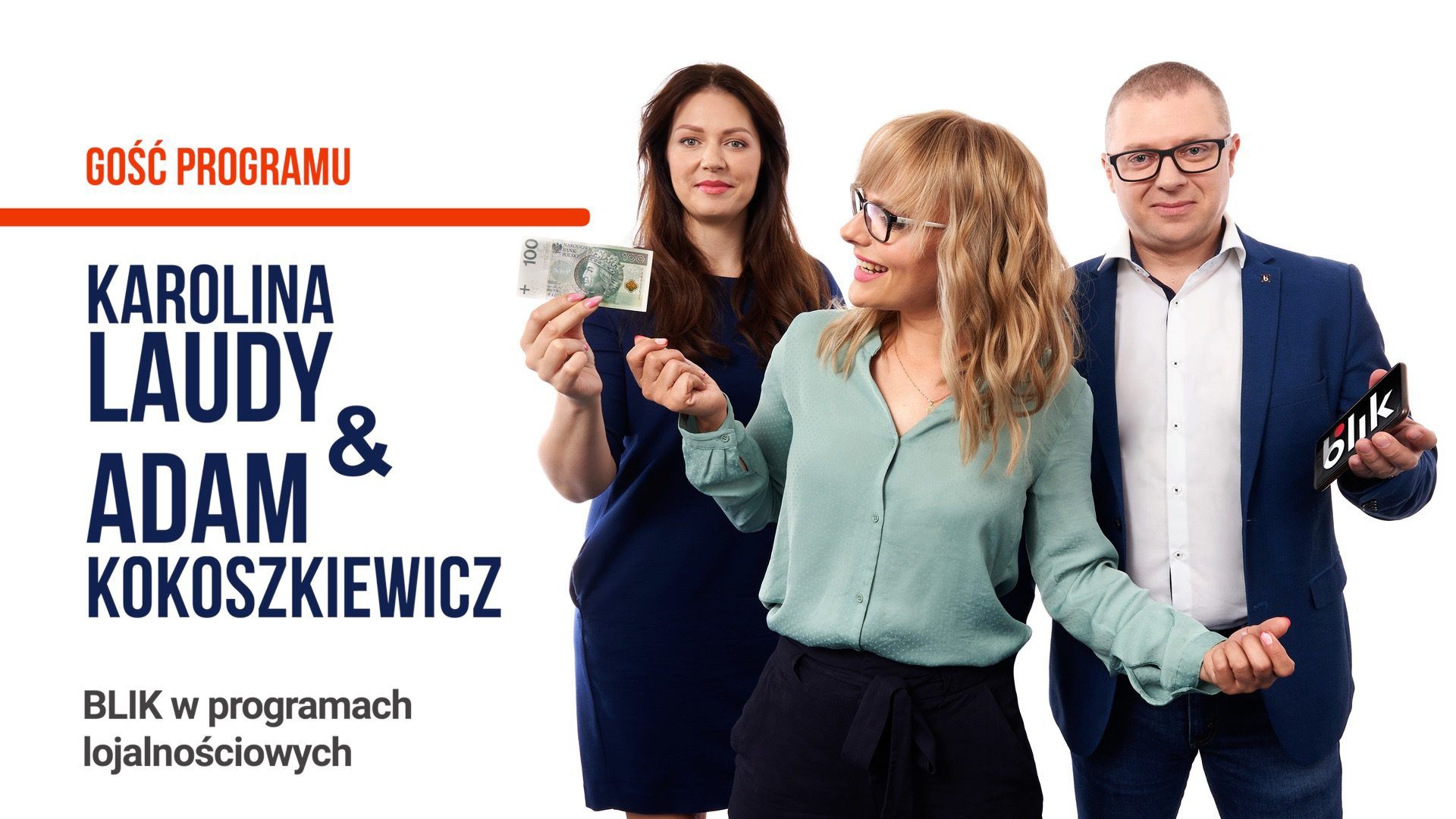
Good evening. Today, for the first time, we’ll be recording an episode for you featuring two guests. We’ll be discussing the Blik payment solution and how it can be used in loyalty schemes and sales promotions. First and foremost, as a method of paying out financial rewards and as an alternative to, amongst other things, prepaid cards. My guests are Karolina Laudy from Santander Bank and Adam Kokoszkiewicz – Head of the BLIK Sales Department. Katarzyna Nawrocka, „On loyalty programmes at night”. Good evening.
Good evening.
Karolina, Adam, I’ve already introduced you both and explained why you’re here in our studio. But I’d like to start the conversation by asking you to tell me and our viewers what links BLIK and Santander Bank.
Karolina, if I may, I’d like to reply first. Polski Standard Płatności is the operator of the BLIK payment system. The company, which provides the service to banks and clearing agents, has seven co-owners. One of them is Santander, which has been involved in the initiative to create a modern mobile payment method right from the start. So we’ve been working with Santander from the very beginning, and we’re delighted that such a distinguished bank with such a large number of users is also one of our co-owners.
Since Adam was the first to reply, we already know how things stand from BLIK’s perspective. However, we really must ask you for your response as well.
From the bank’s perspective, our collaboration involves providing this service to retail customers for payments and the generation of codes – specifically Blik cheques, which can be redeemed at ATMs or via online payments. We also offer related services specifically designed for businesses, including, amongst other things, Blik cheques and the option to make transfers directly to a customer’s mobile phone.
Santander Bank – let me just add – is the issuer, the bank that provides the full range of BLIK services used by customers in mobile apps, but also in the business sector, which we’ll talk a bit more about. How to make good use of BLIK in loyalty programmes.
My next question was intended to explain to our viewers who aren’t familiar with this service what BLIK is. I wanted to start by saying that there are probably very few people who aren’t familiar with it. You mentioned that Santander utilises its entire portfolio, and I’d like to ask you about that portfolio, but also, before coming into the studio, we discussed that I’d take the liberty of stirring things up a bit and say that you’ll be explaining BLIK to our viewers who don’t know about it yet or don’t use it. And above all to me, because I don’t use it.
I feel I’ve been called upon once again to respond, but I’m very pleased to do so. It’s great that we can have a wide-ranging discussion – not just about using BLIK in loyalty schemes, but mainly about how to use BLIK in everyday life. BLIK, as a payment method, operates exclusively within banking apps. What sets us apart from other payment methods is that BLIK is very closely linked to a highly secure banking environment. A banking app is something that makes life much easier for customers, users and all of us these days. Contacting the bank via a device – via a smartphone, which we carry with us practically all the time – doesn’t limit us to branch opening hours or the time it takes to get through to the helpline. It allows us to access all the information from the bank in one place – the app – and on top of that, we have a very convenient payment method in the form of BLIK. BLIK’s core functionality is a 6-digit code. This is a one-off code valid for two minutes, which, when generated in the app, allows us to carry out a transaction. And we can carry out transactions at a wide range of acceptance points. First and foremost, we use BLIK in online shops, where we enter the BLIK code on the website when making a transaction; in high-street shops, where we can withdraw and deposit money using BLIK at ATMs; and it also enables mobile banking users to transfer money instantly between accounts without needing to know the recipient’s bank account number. This is a P2P service – the BLIK mobile transfer – which allows you to send money 24 hours a day, 7 days a week to someone whose account number you do not even know – all you need is their phone number. So, to summarise, BLIK, as a method of payment and financial management, is closely linked to banking apps, and at present virtually all banks in Poland already offer BLIK within their apps.
Karolina, do you feel called upon to respond as well?
I can tell you from a practical point of view what it’s like to use it. Because, just as you said you hadn’t used it before – I also put it off for a very long time. Even though I’ve known about Blik right from the start.
I’m watching Adam’s reaction.
The first time, though, I really did feel – I’d made a big deal out of it. It seemed very difficult at first, but in fact I’ve since gone back to using this payment method very often, because it definitely cuts down the time I spend shopping online or making payments, such as bills and so on. That’s why I highly recommend it, and I’m sure that if you give it a go just once… I use it very often in my daily life; for example, when my nanny needs money quickly, I send her a code which allows her to withdraw cash from an ATM, and I authorise it in the app. So it’s a very convenient way to access money.
I’m really glad you mentioned everyday life, Karolina, because these examples from our daily lives show how this payment method is used. I’d also like to emphasise that the main advantage and convenience of Blik is that we practically always have it with us. This is because we always have our smartphones with us. It’s hard to imagine a situation where we’d go anywhere without our smartphone. We’re more likely to forget our documents, or even cash, but we always have our phone with us. So, as long as we have the banking app with Blik, we have immediate access to our funds. Whether it’s to pay for something, withdraw cash or send money to someone via an instant transfer – that’s what Blik is for. You mentioned that you haven’t had the chance to use Blik yet. I suspect this question is intended to draw me a little further into the discussion: what should a first experience with Blik look like? Historically, when we launched in 2014, the vast majority of Blik transactions were carried out by users at ATMs. People were getting to grips with the technology and learning how to use mobile apps. Consequently, they chose a location that seemed safe to them from a sociological perspective. They wanted to make their first transaction without any third parties involved. If they’d carried out their first transaction in a shop or via a website, it would have seemed less socially acceptable to them at the outset – they worried that if something went wrong, if they made a mistake or ran into a problem, someone might look at me strangely, or that the transaction might not go through. That’s why they chose an ATM, where they could approach this soulless machine and complete the transaction by entering the Blik code. And it was quite a ‘wow’ moment – we weren’t putting anything in, yet we were taking money out. Because with a BLIK transaction, we don’t need any physical tool like a plastic card. All we need is to know that code and confirm the transaction on our device, our smartphone. Now, however, with BLIK having been around for over six years – seven, in fact – we can see that new users making their first transactions are doing so straight away via e-commerce, which is the payment channel where BLIK currently holds the largest market share. So, if you want to use BLIK for the first time, you’ll probably choose e-commerce, because that’s where BLIK’s advantages – ease, speed, security and convenience – are most evident.
The word ‘convenience’ comes up very often in your replies, and I understand that this is one of the key aspects of this solution. I just wanted to chime in regarding mobile apps, because in one of the previous episodes my guest was Tomasz Wit, who discussed the role mobile apps play in loyalty programmes, and I wanted to let you know that you’ll find a link to that episode in the programme description. And now, since I’ve so smoothly moved on to the fact that mobile apps are closely linked to loyalty programmes, I wanted to ask what role the Blik solution might play specifically in loyalty programmes?
In response to your question, a need arose precisely from the day-to-day use of BLIK by customers like us, and both Polski Standard Płatności and we began to receive enquiries asking whether we could develop a product aimed strictly at businesses. We decided, in collaboration with BLIK, to develop a product called Santander BLIK Cheques. The difference is that this is a 9-digit cheque which is cashed at an ATM using a PIN, allowing customers to receive cash directly in a very quick and convenient manner. This is used by companies that wish to run loyalty schemes – that is, they organise a competition and would like to deliver such customer rewards quickly and hassle-free. It can also be used by companies in other sectors, such as the financial sector.
So these cheques are an alternative to outdated methods such as prepaid cards, paper vouchers or simply a standard bank transfer to the account of someone who has taken part in such a loyalty scheme and wishes to claim their cash reward?
Yes, exactly. Because all those products you mentioned earlier involve a whole series of processes. Here, speed and accessibility are our top priorities. We have 20,000 ATMs across Poland, which effectively covers the entire Polish market. We’ve got speed because a PIN is generated and sent to the customer’s mobile number or email address, along with a code – the Blik code. All you need to do is go to an ATM, select a Blik withdrawal, enter these details, and you can access your money straight away.
And that is the most important role of the BLIK solution in loyalty schemes.
Yes. Furthermore, to back up Karolina’s comments, BLIK cheques are widely used in loyalty schemes. I can already reveal that this year we’re bringing back our lottery, called Blikomania. In previous years, it was run and proved very popular with users. Anyone paying with BLIK will be able to register and take part in the prize draws. As for the prizes, we will be paying them out using BLIK cheques generated by Santander Bank Polska, as we believe this is a very convenient, very secure and, above all, modern way of receiving benefits in the form of prize payments. So I can confirm this. Of course, in any loyalty programme where a cash prize is to be awarded, this solution will work very well.
Karolina, now that we know we want to use Blik in the promotion we’re organising: how can we implement this, and what are the steps involved from making the decision to launching the process?
First and foremost, if the company is already a Santander Bank customer, all it needs to do is contact its bank manager. If not, however, simply visit your nearest branch. We’ll organise a meeting together, as we need to assess your requirements in terms of usage – that is, the number of Blik cheques that will be processed. In other words, what the scale will be and how large the project is.
What kind of loyalty scheme are we planning, or what sort of prize draw are we organising?.
Exactly. And how many recipients of these cheques are we planning for? Because this has a significant impact on the implementation later on. We also need to assess the company’s existing IT infrastructure, as we offer both fully automated and semi-automated solutions. And here, we tailor our implementation and the integration between our systems to the technological sophistication of the company approaching us. Next, we open accounts that will be used strictly for the payment of these cheques, as well as for processing and fulfilment. And that’s the whole procedure. You need to allow around 10 working days for the implementation of a fully automated system, so it’s important to bear that in mind.
This is a very important message – 10 working days.
Well, that was quick.
Yes. That’s an average of 260 hours.
And how is the cost model for implementing this solution structured?
We have several implementation models in place, which, as I mentioned earlier, depend on the level of technological advancement. This is because we have solutions that are fully automated and operated via an API, which we have integrated directly with the company in question. However, we also have semi-automated and even manual solutions, should the need arise. So it really depends on the company and how prepared they are. In addition, we also assess the number of cheques issued – that is, the business potential we see here. And all these factors contribute to the final price of this product for companies.
The use of Blik technology represents an innovation in loyalty schemes and lotteries. Could you tell us more about this?
Adam, I think your example is definitely better.
Adam, you have been called upon to respond.
I’d be happy to answer, but I think Karolina will add to my answer. This is because, first and foremost, Santander Bank – which has a direct relationship with customers and businesses – wishes to utilise BLIK, a modern tool, within its loyalty programmes. Let’s bear in mind that BLIK is a universal solution; it’s not just for loyalty programmes, but can also be used for other methods of offering benefits and transferring funds. Santander Bank has extensive experience in this area and, I believe, a broad portfolio – I mean, you certainly do have a broad portfolio.
Yes. We actually started out with loyalty programmes. Some of the first companies to approach us were specifically keen to distribute rewards to their customers very quickly and easily. And that was our first project. However, we actually realised that the system could also be applied to day-to-day business operations. Firstly, when we have staff spread across various branches and, for example, the accounts department is based in a different town, we can quickly settle business travel expenses, such as an employee’s costs. Additionally, we can utilise this specifically for financial matters. There are a great many credit companies – not necessarily banks – that grant loans, and customers do not always use their bank accounts, or do not want the money transferred to their account, but prefer to receive cash. This is an excellent solution that also works well for all types of lending companies.
And for how long has BLIK been used in loyalty schemes and lotteries?
Here at our company, we’ve been working with the Polish Payment Standard for five years now, and as I was just saying, we started with a loan company and an advertising agency, which used the system for a loyalty scheme.
As a Blik operator, we receive on average between a few and a dozen or so enquiries about this type of solution, and as we know that Santander Bank has been offering it successfully for many years, we pass on their contact details, after which customers arrange the terms of the arrangement directly with Santander Bank.
We’ve had lots of enquiries about this solution and have been working together for quite some time, so we can safely say that it’s a very good and convenient solution when it comes to BLIK. What about loyalty schemes?
Yes. First and foremost, it’s convenient and quick. That’s important too, because these days we all want quick access to funds, and this gives companies the peace of mind that they can bring joy to their staff or customers by providing access to money within a very short space of time.
So we have convenience, time – time saved – a network of ATMs – a very extensive network – and minimal paperwork. Now let’s move on to security. I’d like to ask you what the standards are regarding the use of a Blik cheque by a user who has taken part in a loyalty scheme and wants to cash in their reward.
BLIK cheques are secure. First and foremost, users receive… The user receives information from two sources. One is the BLIK code that comes with the cheque – that is one source of information. The second, independent source is the PIN for it. Furthermore, the code – this BLIK cheque – is single-use only. So it cannot be reused. The PIN entry process is set up exactly the same way as for mobile phones. This means you have three attempts to redeem the cheque. If you enter the PIN incorrectly, the cheque will be automatically cancelled and the customer’s phone number blocked.
Verification of the BLIK cheque and PIN is carried out via our system, which guarantees complete security, as every transaction is authorised within the banking system. We use an authorised and licensed network of ATMs in Poland, provided by institutions supervised by the Polish Financial Supervision Authority. So, anyone who obtains a Blik cheque and PIN from a secure banking source can feel completely confident that the transaction they carry out at an ATM will be not only quick and convenient, but also secure. Karolina made an important point here regarding the single-use nature of such a cheque. It is important for users, and for companies wishing to reward their customers, to ensure that the rewards are commensurate with the value of the cheque. Because if, for example, the reward were 100 zlotys and someone wanted to withdraw 50 zlotys twice, they would need to receive two vouchers. And this is, above all, about raising user awareness of the amount they can redeem with a single voucher. I’d like to add here that, in practice, Blik is currently the most secure payment method, as it is carried out within a secure banking environment. As I mentioned, it is generated within banking apps or by the bank in the form of cheques. And every transaction is confirmed. In the case of a cheque, this is a PIN; for transactions within the app, it may be facial or fingerprint recognition, or the app’s PIN – depending on how we set it up. But the fundamental element of Blik’s security is that we confirm every transaction. This means we carry out transactions consciously, and this also builds a sense of complete peace of mind regarding security among users.
This may be a very basic question, but I have to ask it. When it comes to using cheques, does this apply solely to loyalty schemes, or do you also use this method in other areas?
As I mentioned earlier, we also use this for payment integrators, who bring together other shops and distribute our cheques. In addition, there are loan companies. They want to ensure that money is quickly made available to customers applying for a loan. So these are the most common and widespread ways in which Blik cheques are used.
And that’s how we answered the question of how to use BLIK in B2C.
Exactly.
BLIK, as a universal payment method, is primarily used in online shops, high-street shops, for cash withdrawals at ATMs, and for transfers to a mobile number. The fact that our mobile app supports BLIK means we do not need any additional tools, such as other payment methods, to complete our transaction following the same process. Generating a code in the app and entering it into the accepting device – be it in a high-street shop, an online shop or at an ATM – and then confirming the transaction in our app. This workflow is so universal that people who have carried out their first transactions can comfortably carry out subsequent ones without having to learn new steps or follow a different procedure. With Blik, it’s the same everywhere. So Blik’s widespread use in consumer transactions is the driving force, the flywheel, the engine that has led to over 8 million people currently using Blik.
All right, but we have plenty of options, plenty of apps and plenty of devices and mobile solutions that allow us to make payments or withdraw cash. Why BLIK, of all things?
First and foremost, it’s a quick solution – and that first step is always the hardest; very often we fall back on our habits when using other payment methods, especially when there are a number of alternatives available. However, what sets BLIK apart is also its availability. In other words, when it comes to online transactions, BLIK is accepted practically everywhere. Other payment methods, on the other hand, may require special software, devices or, at times, specific brands. And it may well be that just because I can make a payment on my phone doesn’t mean I’ll be able to do so on a computer if, for example, I’m having a coffee in the meantime and want to pay for something. BLIK, on the other hand, is adapted for both mobile and desktop devices. There are also solutions in place here that allow you, as a user, to make the process as simple and user-friendly as possible; for example, if you’ve made a payment once – and I’m a Santander Bank customer – BLIK, in collaboration with Santander, will then automatically link my account number to the service; for example, if during the first transaction you provide additional confirmation via the mobile app. For the second transaction, if, for example, you prefer to streamline your shopping experience, all you need to do is confirm that this BLIK code is linked to your account number – this is the so-called „BLIK One Click” solution, where you simply need to accept it and your payment will go through; you don’t need to do anything else, whilst maintaining the same security standards. Additionally, when shopping online, you can embed – that is, the field for entering the code – you can embed the Blik code directly on the website whilst you’re in your shopping basket, meaning you don’t have to go through any further steps; you can simply enter the code directly on the shop’s website and accept it in your mobile app.
The widespread adoption of Blik has been a success primarily because our payment method is integrated with a bank account. There is no standalone Blik app. Blik is a payment feature that is implemented within a banking app. This also offers a significant advantage from a psychological perspective, as we, as users, want to be sure above all else that a transaction will be secure before we go ahead with it. At present, banks, with their monitoring systems and security measures, are the most secure providers of financial services. Consequently, a payment method that is strictly linked to a bank offers this advantage. And that is why Blik has been so successful with users – because it provided that element of security. And then there’s what we like best: the convenience and speed of the payment process. Let’s remember that everyone enjoys shopping. Paying, not necessarily. However, the moment when we make a payment should be as unobtrusive as possible within the entire shopping process, so that the transaction goes through securely and we can enjoy the goods or services we’ve received. That’s why Blik offers users this whole range of possibilities, and that’s what makes it so popular.
All I’ll say is that the only limit to Blik’s potential is our imagination. Because, really, if a company comes to us with an idea for how to use a Blik cheque, we’re obviously open to it. Together, we can develop new solutions and new applications.
Well, yes, but we already know that BLIK cheques can be used primarily in loyalty schemes and lotteries. You mentioned that everyone likes shopping – not necessarily paying, but everyone also likes winning prizes. So now we know why BLIK is so popular. And we know that it’s a brilliant solution, particularly for companies that run loyalty schemes and lotteries and want to use it to quickly and securely pay out the prize – a cash prize – to the winners.
Yes, indeed.
I’m glad you’ve confirmed this.
Yes, we can confirm that. Definitely.
We’re coming to the end of our conversation and, of course, I’d really like to thank you both for being my guests and for explaining, from A to Z, how Blik can be used in loyalty schemes. Is there perhaps anything you’d like to add to round things off?
Karolina, if I may, I’d like to share the results of a Kantar survey here, which showed in 2020 that Blik is the most popular mobile payment method. Many people wonder what lies behind Blik’s success. Karolina and I have already mentioned the convenience, security, speed, versatility and reach of our payment method. However, I’d like to inform you, Karolina, and our viewers straight away that, for this year, at the turn of the third and fourth quarters, we’re planning to make paying with Blik even more convenient, particularly for customers in high-street shops. We are introducing contactless Blik payments, where you simply hold your phone up to the terminal to complete the transaction. We realise that Blik’s success lies in the convenience it offers our customers, which is why we are launching this initiative and will be making it available later this year.
Yes, more and more companies are contacting us to ask whether we can process Blik transactions on the bank’s side – that is, by managing accounts for these companies. We invite any companies interested in working with us to get in touch.
Adam, you mentioned off-camera that you’d like to give our viewers a link to take a look at this research.
Of course. I’d encourage you to have a look. These are the findings of a professional firm that has gathered a range of market data to back up what we’ve been discussing today.
I promise that this link, just like the links to the previous episodes I mentioned, will be in the description of today’s session. And thank you all for joining us today.
Thank you very much.
Thank you very much for the invitation.