

Transcript of the episode: https://www.youtube.com/watch?v=vMu_nZfhbnU
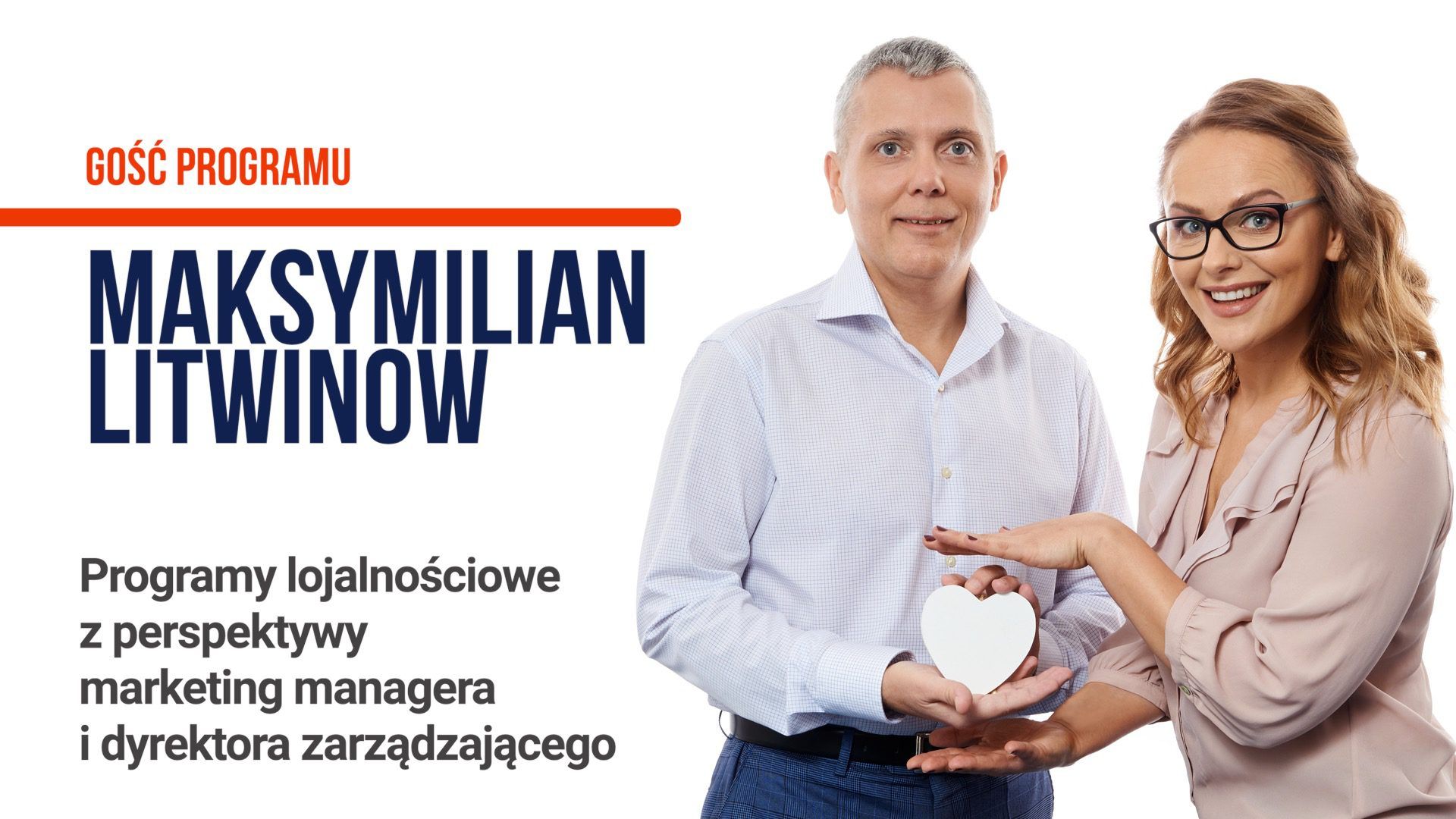
KN: Loyalty programmes from the perspective of a marketing manager and a managing director. Katarzyna Nawrocka, welcome to today’s episode. Today, I have the particular pleasure of welcoming Mr Maksymilian Litwinow, managing director of Rebel Media, who has many years„ experience as a marketing director for international retail chains in the food sector and, amongst others, the ”do-it-yourself’ sector. My guest is someone who combines experience in organising and managing loyalty programmes, both from the perspective of someone directly involved in running them, a manager responsible for leading teams overseeing loyalty programmes, and a managing director of organisations for which loyalty programmes are one of many tools for managing customer relationships. Thanks to this unique combination of experience and expertise, today we will be able to discuss how the perspective on loyalty programmes changes for someone who is successfully climbing the career ladder. Thank you for accepting our invitation to today’s discussion.
MI: It’s a great pleasure for me too. Good evening, everyone.
KN: Mr Maksymilian, you have a wealth of experience in running loyalty schemes for leading retailers in Poland. When did you first come into contact with a loyalty scheme in a professional capacity?
MI: I first implemented a loyalty scheme in November 2006. It was the „Rodzinka” loyalty scheme at the Carrefour chain. It was a points-based loyalty scheme. We had a whole host of gifts and rewards for our customers, which could be exchanged for points earned whilst shopping at the supermarket chain. I remember that in every shop we had a special display case where these gifts were displayed. In 2006, they attracted a great deal of interest from customers. I remember the crowds that would gather in front of the display window, with everyone’s eyes fixed on the DVD player, which was the dream of many Poles at that time. Of course, we also had a gift catalogue in which all these gifts and rewards were presented in a very attractive way. I remember that these catalogues were also hugely popular with our customers. The programme itself was launched in 2006, although preparations for it had begun two years earlier, so you could say that my professional journey with loyalty programmes began in 2004. And going back to the programme, it was very, very innovative for our customers. Back then, the ‘Rodzinka’ loyalty programme was a really major event in the retail sector. Firstly, we provided a really cool card with two key rings attached – this was something new and allowed the whole family, as it were, to accumulate points very quickly together as part of this loyalty programme. The second very interesting aspect was the communication itself. Back then, of course, there was no social media or widely available internet, so all communication relied on direct mail to customers’ homes; in other words, we sent letters containing personalised content, in which we thanked customers first and foremost for taking part in this loyalty programme and for their loyalty to our company. We sent out discount vouchers, as well as all the information relating to what was happening within the programme and any new changes. Of course, from the other side – that is, from the perspective of analysis and customer segmentation – a great deal of work was carried out here, as all the vouchers we distributed to customers were based on segmentation. Naturally, the scheme was fairly straightforward: it was RFM segmentation, or certain clubs we’d set up, such as the young mums’ club or the animal lovers’ club, so as to create interesting, personalised value for the customer, but also, of course, from the retailer’s perspective, to drive sales and build customer loyalty. Of course, those were times when loyalty programmes weren’t as popular, and it wasn’t possible to copy them very quickly or carry out market research to see what programmes were in place and how best to set one up, so we relied a little on the support of our colleagues from the parent company in France. We also had a consultant on board who worked with us on this programme, but it’s very important to note that the programme was developed entirely in Poland by a Polish team and took full account of Polish customers’ preferences.
KN: Please tell us about the key insights regarding building end-customer loyalty and motivating sales representatives. Insights drawn from your more than 20-year career in leading marketing departments and managing businesses.
MI: Personally, I believe that customer loyalty is one of the greatest – indeed, arguably the greatest – resources a company has. It is the greatest asset that, in fact, every retail business possesses. That is why loyalty programmes are extremely important, not only in terms of building loyalty and providing benefits to customers, but above all in terms of understanding their needs. As we know very well, loyalty programmes allow us to define a customer’s profile with great precision – their preferences regarding specific purchases, their lifestyle, the frequency of their purchases, the times they shop, and the products they like – and this knowledge is extremely important for the entire organisation. It is important, for example, from a marketer’s perspective, as they can use this information to devise an effective campaign that is tailored to the needs of a specific customer. Today, it is fair to say that we live in an era where communication is moving towards a one-to-one approach, where there is no longer such a thing as the ‘average Pole’, and where we prepare an offer for each individual that is perfectly tailored to their needs. On the other hand, we also have enormous analytical capabilities in other departments. Whether this relates, for example, to pricing policy or the product range we wish to offer our customers. The whole issue of analytics, when it comes to marketing campaigns, their effectiveness and their impact on the customer. So, the main conclusion regarding building customer loyalty and utilising loyalty programmes is that I believe there is enormous potential – often untapped – in analysing loyalty-building activities based on an understanding of of customer behaviour – and, of course, utilised not only in the context of the benefits themselves, but as part of a broader concept or the development of a retail strategy for customers.
KN: And what role does a loyalty programme play within a company’s management structure?
MI: To properly define the role of a loyalty programme within a company’s management structure, we must first and foremost ask ourselves what we actually hope to achieve from it. And, of course, in the planning stage – particularly when the programme is being developed and the implementation phase organised – everyone is highly motivated, and top management also attaches great importance to it, because on the one hand it represents a huge investment, and on the other, there are also huge expectations. There is always a great deal of enthusiasm surrounding the programme, and everyone is absolutely convinced that it will be the element that builds a competitive advantage. But as time goes on, routine very often becomes a major threat here, and if this loyalty programme is eventually reduced solely to the role of a marketing tool, then its value to customers and to the organisation gradually becomes less and less significant. That is why it is extremely important to structure the loyalty programme within the company in such a way that it is not merely a marketing tool, but an integral part of the company’s overall strategy. This is extremely important because then, in effect, every member of the team is able to benefit from all the advantages that a loyalty programme can offer. For decision-makers, it is an extraordinary tool, because, as I said, a loyalty programme primarily provides vast amounts of data. The more of our customers who are members of the loyalty programme, and the greater the share of turnover generated by these members, the greater the confidence in decision-making. We now live in an age where this business intuition is an added value. However, when it comes to specific business decisions, these are usually made on the basis of certain analyses and on the basis of knowledge. That is why a loyalty programme provides this knowledge; if this knowledge is properly utilised and distributed within the organisation – be it in the marketing, sales or logistics departments, or at board level – I am convinced that This knowledge can certainly be used to shape even the company’s overall strategy. Of course, it’s all very easy to say, but I’m convinced that many companies currently running loyalty programmes have fallen into a bit of a rut, and have encountered certain problems stemming from the fact that there is a vast amount of data that needs to be analysed. It’s quite complex. The conclusions that should be drawn from this programme are not that easy to formulate. That is why I believe that marketers, too, should not be afraid to ask for help. Firstly, they should foster a culture within their organisation of looking at the loyalty programme with a fresh perspective. By all means, they can bring in an external firm which, firstly, is very much in touch with all the market trends, and secondly, understands all the technological changes taking place within loyalty programmes – changes that allow for much better analysis, for example, through artificial intelligence – and which can also provide an external perspective, free from all the internal issues, dynamics, „excuses” we might have, to identify what is truly valuable in a given programme, draw conclusions from customer observations based on the data we hold within the loyalty programme, and recommend certain changes that should be introduced to the programme, or suggest ways of communicating with customers, or presenting a specific offer or promotional campaign, so that the programme becomes increasingly attractive to customers with each passing day, so that it continually builds that loyalty, and so that it serves as a fantastic tool for top management in making strategic decisions.
KN: The end of the year is always a time of intense planning. What role do loyalty schemes – both those aimed at end consumers and those aimed at businesses – play in a marketing plan?
MI: It is true that the end of the year is a busy period, with budget preparations and planning for next year’s activities; and whilst loyalty programmes must, of course, be planned within the context of loyalty programme tactics, as I said, they are also a huge source of insight into all the activities we’ve carried out over the past year. So, from a planner’s perspective, or from a marketing director’s perspective, a loyalty programme will certainly be a source of immense insight into the evaluation of promotional campaigns. On this basis, we can see how many customers we have managed to attract, what business results the campaign has delivered, what the difference is between loyalty programme participants and those who do not participate in the programme, as well as changes in customer behaviour resulting from a particular activity. On this basis, we can assess, for example, which campaign was a huge success and led to the achievement of business objectives, which campaign should be modified in some way, and which campaign might not be worth repeating because its results were very poor. But this relates solely to marketing activities; within the loyalty programme itself, appropriate tactics must of course also be planned, because to build customer loyalty, above all, you need to maintain constant contact with them. They must receive communications, and these must be sent at the right frequency. These must be properly personalised. They must contain content that is accessible to the customer in question and must offer a certain value that will constantly reinforce the customer’s belief that the brand they are currently with is the one they truly love. A loyalty programme is not just about data that can be used solely by the marketing department. We can successfully utilise data from the loyalty programme in other departments. Take, for example, the sales department and the period of commercial negotiations with business partners. A great deal of information regarding customer behaviour, product consumption, brand perception and the frequency of purchases of these products comes from the loyalty programme. I am absolutely convinced that, for both sales representatives and business partners, this type of data is an incredible source of information; and during discussions and business negotiations, it certainly serves as a fantastic argument for planning joint activities for the coming year.
KN: What methodology should be used to plan the costs of running a loyalty scheme?
MI: Firstly, I would like to emphasise that planning the costs or budget for a food programme is a rather complex process, but also an extremely important one from the point of view of maintaining quality and developing the loyalty programme. Of course, when it comes to planning, it is somewhat similar to drawing up a budget; there are many unknowns that may arise in a given year, but naturally, one must take into account a great many factors that may influence these costs. Firstly, it is important to remember that a loyalty programme is not a one-off initiative; it is not a campaign; nor is it even a few weeks’ worth of activity – rather, it is a long-term investment which will incur certain costs over many years that the organisation must bear. So it is a huge challenge for marketers and management boards to estimate these costs in such a way as to build a profitable loyalty programme. The second issue is the overall cost structure. Of course, apart from the obvious aspects such as benefits, rewards and cashback for customers, there are a number of other costs associated with a loyalty programme. These include, for example, the costs associated with all customer communications; the costs of the logistical running of the loyalty programme; and all the investment costs involved in building the IT infrastructure, as well as its maintenance. These include all sorts of costs associated with research into the loyalty programme and its development, as well as staff costs, as the team working on the loyalty programme will also require funding. Of course, it is extremely important to estimate this as accurately as possible, as the risks are enormous. If the loyalty programme is underestimated and it turns out, for example, halfway through the year that the budget that was planned is insufficient, drastic measures may be taken which will have a very significant impact on the quality of the loyalty programme. These could range from what might be described as rapid measures, such as cutting back on communications – which would also have a very negative impact on customer engagement – right through to measures that might in some way lead to a reduction in the benefits we have promised our customers. So, from the perspective of maintaining the programme’s quality, this is something very, very dangerous; and let us remember that we are not talking about the entire customer base, but rather about the group of customers who are most loyal to the brand. So if the quality of the programme is poor, if we let them down in the delivery of this programme, if we fail to communicate with them properly, we risk causing dissatisfaction amongst a group of customers who are, so to speak, our brand ambassadors.
KN: Mr Maksymilian, is it possible to accurately estimate the profits the organiser will make from running the loyalty scheme? Is it possible to calculate the ROJ from organising the scheme?
MI: Yes, it is possible, and it is extremely important. Of course, when it comes to precision, I would be very cautious. A loyalty programme is, so to speak, a living organism; there’s a lot going on, many things can be measured very precisely, whilst for many others we must, so to speak, rely on our intuition or business acumen and reap additional benefits as an organisation from the loyalty programme. Of course, when it comes to the ROI of a loyalty programme – its profitability – it should be tailored and structured in such a way that it always generates profits for the company. If it remains an investment at all times – and we’re talking about long-term programmes here – then it will, to some extent, be a burden on the organisation. So it needs to be balanced in such a way that, on the one hand, it is attractive to customers – ensuring that the benefits they receive are appealing enough to keep them in the programme. On the other hand, of course, it must provide the entire infrastructure needed to run the loyalty programme, as well as for data analysis. But the profit resulting from increased purchases, from attracting new customers or retaining existing ones, must be large enough for the programme to be self-financing. And, of course, we can calculate the ROI for the loyalty programme; we can compare customer behaviour, average basket sizes, and the value of a loyal customer compared to that of a customer who does not participate in the loyalty programme. And, of course, here we can draw on a vast body of knowledge, as there are many publications on loyalty programmes, and we can easily say that factors such as visit frequency, or average basket size will always be higher for loyal customers than for those who do not participate in a loyalty programme; but there are also a host of other factors that allow us to assess the ROI of a loyalty programme in some way. Take, for example, the campaigns we run: we can also create specific customer segments, dividing them into groups of people who are, in some way, stimulated by marketing activities. And a second group of people who are not covered by this promotion. Here, we can calculate with a high degree of precision what the difference is for a given specific activity. Of course, it is also common knowledge to all of us that retaining a loyal customer is much cheaper from a marketing perspective than acquiring a new customer and building their brand loyalty. Another element, which is perhaps less quantifiable but also extremely important, is the entire knowledge base that is built up around the loyalty programme. As I mentioned earlier, this is a form of capital that is accumulated within the organisation. We get to know our customers; we know how to adapt to their needs; we know how to carry out activities in such a way that they are well received by our customers, and in the long term this builds a competitive advantage in the market. So this is perhaps a value that cannot be expressed in figures, but it is certainly a huge asset that influences the value of the entire loyalty programme.
KN: Did your view of the loyalty scheme as a marketing technique change when you were promoted from the role of marketing director to that of managing director?
MI: Personally, I don’t think one’s position within the organisation really matters that much. What is far more important is understanding the loyalty programme, its place within the organisation and the benefits it brings. Whether it’s the marketing director, the managing director or the sales director, they can all certainly make use of it. And now, of course, what usually happens in organisations is that the marketing director is closest to this loyalty programme; they run it, and develops it; they are, so to speak, the disseminator of the insights and conclusions drawn from the programme. However, how that knowledge is utilised – whether by the sales director or the managing director – is ultimately an individual matter when it comes to those in top management. So, from my perspective, it doesn’t matter whether you’re the managing director or the marketing director. It is much more a question of whether I believe a loyalty programme can be part of a concept that will help me manage the company strategically, or whether it is simply a standard marketing tool which, like other marketing activities, forms part of specific promotional campaigns carried out for the customer.
KN: And what would you advise heads of sales, sales and marketing, and marketing to focus on when planning loyalty initiatives?
MI: So, of course, planning activities as part of a loyalty programme should begin, first and foremost, with an analysis of the data available from previous activities. In other words, we need to take stock of how the loyalty programme performed over the past year, and then ask ourselves which of these activities yielded the greatest, most tangible results in terms of delivering the company’s strategy. The second element, which is extremely important, is the programme’s appeal. Every supermarket and every sales director should ask themselves: ‘What can I do next year to make this programme appealing to my customers? What can I come up with to engage them even more in shopping at my store? This is extremely important because our environment is changing very, very quickly. Our competitors are introducing certain technological solutions, customer behaviour is changing slightly, and there are a great many different and interesting campaigns – whether promotional or loyalty-based – being run by various chains. That is why it is extremely important to stay on top of things, to monitor the market, but also, of course, to consider whether what we are planning is consistent with our company’s strategy. Often, too, rapid changes driven by the market, by competitors or by shifts in customer behaviour can slip through the net, and sometimes the company’s strategy gradually begins to drift slightly away from the loyalty programme, or actions within the loyalty programme are not adapted quickly enough to changes in direction, or to certain updates relating to the development of the company’s strategy. This is extremely important, because this alignment between the loyalty programme, the company’s strategy and the brand concept guarantees success and ensures the brand is perceived as a single, coherent whole. We must also bear in mind the need for flexibility. Gone are the days when big companies swallowed up the small ones. These are the days when fast companies swallow up the slow ones. So if anything happens in the market, if we see certain changes in behaviour, our response should be extremely swift; and when planning marketing activities or initiatives within the loyalty programme, we must always maintain a certain degree of flexibility and react fairly quickly, whenever situations arise that might in some way enhance our market image or strengthen customer loyalty; we must also respond to events affecting our customers and swiftly provide them with solutions that can improve their quality of life.
KN: What do board members of companies running loyalty schemes expect from marketing and sales presentations that discuss the performance of loyalty schemes?
MI: Of course, it is very difficult to generalise here, as both the level of knowledge about loyalty programmes and the approach to them vary across different management teams, but if I had to ask such a question, I would certainly phrase it as follows: how does a loyalty programme support the development of the company’s strategy and how does it help to implement it? The next question is whether a loyalty programme, as a tool, is more effective than the other tools available to us within the organisation. I think that every marketer, every person who runs a loyalty programme, should ask themselves this question before attending a board meeting or having the pleasure of presenting the results of the loyalty programme, because, to be honest, anyone responsible for a business or organisation will want to understand whether this is the best way to build customer loyalty and, through that loyalty, achieve the company’s strategic objectives. Of course, marketers should also analyse their environment; they should gauge the level of understanding regarding the loyalty programme and its potential amongst the audience to whom they will be presenting. So, on the one hand, this must, of course, be very concise information which, in some way, shows these busy board members how the loyalty programme works and what benefits it brings; but there should also be certain educational elements to highlight the programme’s potential, to highlight how we can make even better use of it, and ultimately to encourage board members to make use of this loyalty programme themselves. This is of immense importance because, in reality, it will ultimately determine the role the loyalty programme will play within our organisation. Either it will be treated as a mere marketing tool, which will, in a sense, simply provide a stream of further initiatives that we will carry out as part of this programme. Or it will be an integral part of the concept, a strategic knowledge base that will be widely utilised across the entire team and the whole organisation.
KN: Why did you never decide to join any of the loyalty schemes that you incorporated into your multi-partner programme? Let’s also discuss what factors led you to run your own ventures dedicated to a single chain.
MI: It’s true that, whilst running loyalty schemes across various retail chains, I received proposals from multi-partner schemes to join them, and each time, of course, it wasn’t a trivial decision; it wasn’t simply a matter of saying ‘no’ because I didn’t want to, but it was a matter of careful analysis, and here one must bear in mind that it is difficult today to say that a stand-alone programme is better than a multi-partner programme. Both have their benefits and their strengths. As for an in-house programme, the overwhelming argument in favour of this type of programme is the complete control over its design, full flexibility and full access to all the knowledge gained through the programme. So, on the one hand, we have a great deal of independence, but on the other hand, we are limited to a specific group of people within our network who have the opportunity to become familiar with the loyalty programme. A multi-partner programme, on the other hand, offers enormous reach, because we immediately have access to various sectors, different companies and a whole host of customers. We also benefit from the fact that these customers are able to collect points much more quickly, or receive any other benefits, because they collect them not just within a single network, but across various outlets. And then there’s this diversity, which also gives customers the opportunity to earn benefits not only when, for example, they’re doing their weekly shop, but essentially whenever they interact with a brand participating in this multi-partner programme. In my career, I have never decided to join a partner programme, and this was largely dictated by strategy and the role of the loyalty programme within the organisation. The loyalty programmes I’ve run have always been an integral part of the shop concept; they formed the foundation of the entire business plan. And here, the management’s vision – and mine too – of how we wanted to develop it, and how we wanted to influence the image of that loyalty programme, was far more important than simply building reach. And the second, very strong argument was that, given the fact that the loyalty programme was a fundamental element of the organisation, the issue of its image was also extremely important to us; in a multi-partner programme, of course, we attach enormous importance to the organiser of the loyalty programme. It is this multi-partner programme that is, in fact, the star of the show, whilst all the entities participating in it are, so to speak, merely providers of benefits; in other words, the brand is built within the framework of the loyalty programme, not the distributor’s programme. And the final element, which is extremely important in this area, is the issue of flexibility. It is well known that if we have a multi-partner programme, it must, to a certain extent, be such that any changes made within the programme must be accepted by all partners in the partnership scheme. If we have our own programme, we can modify it as we see fit, focusing solely on the needs of our direct customers.
KN: And finally, Mr Maksymilian, based on your professional experience, what are the three most important pieces of advice you would give to those promoting the launch of the ‘be to see’ and ‘be to be’ programmes?.
MI: The first piece of advice concerns the positioning of the loyalty programme within the organisation as a whole. Personally, I have never regarded a loyalty programme as merely one of the tools of marketing. I have always viewed it more broadly, as part of the company’s overall strategy, and I believe this gives the loyalty programme a special place within the organisation, allowing its full potential to be realised. The second thing, which is extremely important, is the issue of flexibility – in other words, a loyalty programme must be dynamic. It is not a project. It is a process. It is a long-term investment, but one in which we have devised certain solutions and have been replicating them for 20 years. We must constantly analyse what is happening within the programme; we must constantly analyse what is happening in the market; we must constantly adapt to our customers’ needs; and we must constantly understand how we, as a company, can better deliver value to our customers. Because the loyalty we’re actually building isn’t about buying our ambassadors’ engagement with the brand through points, cashback or discounts. It’s about building a bond, building a relationship between customers and the brand that goes beyond the purely transactional level. It’s a matter of communication; it’s a matter of dialogue with the brand. It’s about the feeling that, as a customer, I have a say in how the brand I engage with, the products it offers, and the retail chain where I shop are tailored to me, and whether the offers I receive are bespoke and suited to my needs and expectations. And last but not least is the issue of making full use of the quantitative programme. Drawing on the insights this loyalty programme provides, we can effectively manage many areas of our business. On the one hand, this gives us comprehensive insight and enables us to act on the basis of concrete evidence; on the other hand, it also affords us a certain degree of freedom and confidence in the quality of the strategic decisions we make. If we succeed in building a large community – a large group of brand ambassadors – we can then successfully utilise this not only in terms of incentivising customers, offering benefits or building our business on the basis of these loyal customers, but also by, as it were, extending the quality and perception of our brand to other people, to other family members, and to the friends of these ambassadors. So certainly, to sum up, a loyalty programme is a fantastic tool; one might even say it’s more than just a tool. It’s a certain element of the concept, a certain element of the work culture, and I think, that even when comparing the period from 2004, when I first started working on the programme, to the present day, a great many things have obviously changed – both in terms of technology, customer behaviour and the opportunities available to marketers, but I think that the value of a loyalty programme has remained constant – as an element that is not merely a standard benefit for customers linked to marketing activities, but one that offers much more; you simply need to make the most of it.
KN: I’d like to thank you very much for that advice and for the excellent summary, and I hope to see you again.
MI: Thank you very much. See you soon.
KN: And I invite you all to tune in to the next episode.