

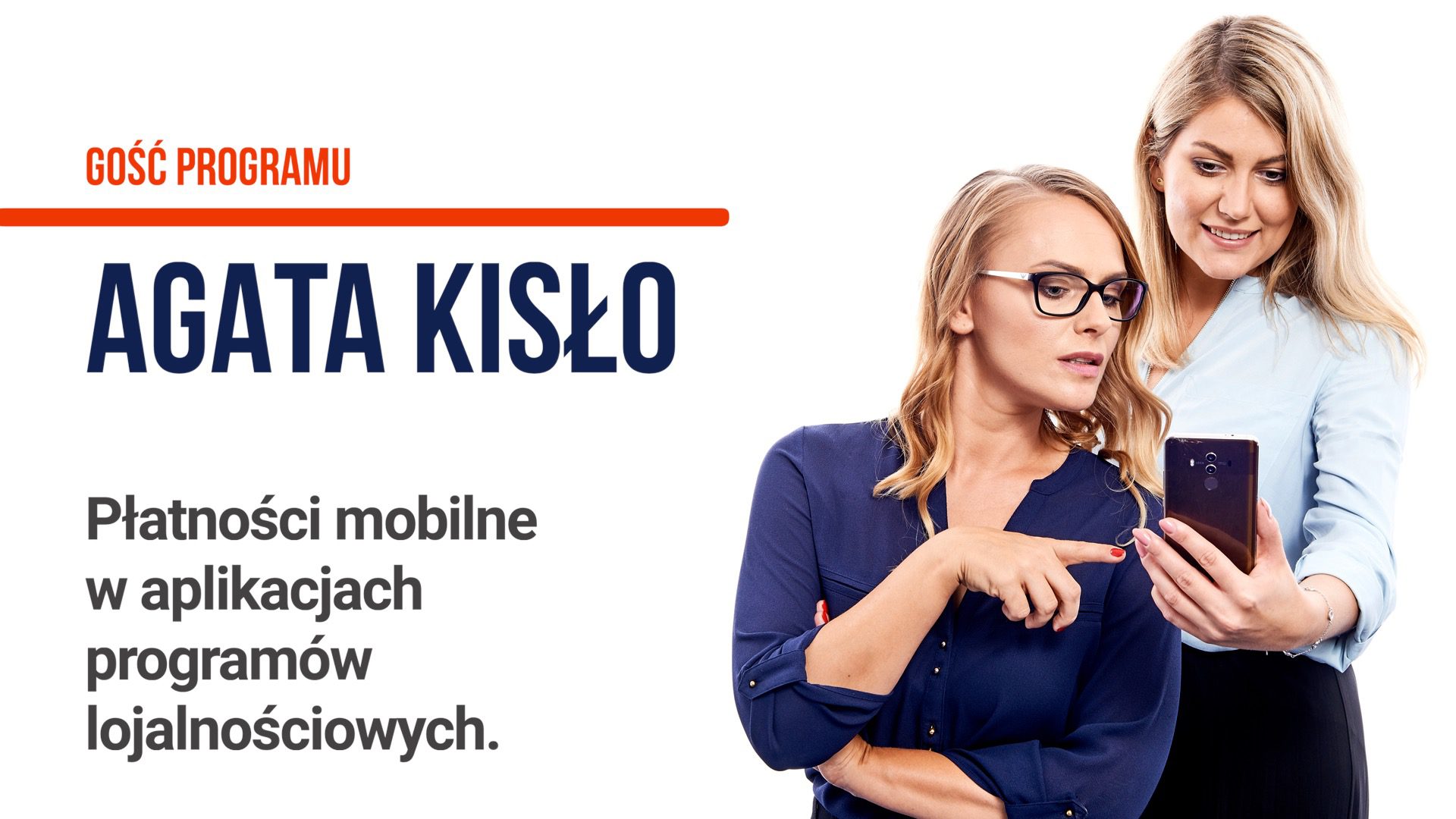
Transcript of the episode – https://www.youtube.com/watch?v=DRNtlw2Fc3w
KN: Good evening, this is Katarzyna Nawrocka speaking.
AK: And Agata Kisło.
KN: Loyalty schemes at night. It’s lovely to have you here again; we’ve been talking about mobile apps and we’ll be exploring this topic further.
AK: Today, I’d like to talk about mobile apps for loyalty schemes that allow us to make mobile payments.
KN: We’re focusing on payments, so let’s start by looking at what this means for mobile app users.
AK: For mobile app users, this means they can make payments using their phones, on which they have the loyalty programme’s mobile app installed. This is quite a complex topic, so I’d also like to explain how it works, because, as I’ve already mentioned, mobile apps are part of our everyday lives, particularly when it comes to our daily shopping, and many of us simply pay with our phones these days.
KN: Let’s explore this topic further – what’s it all about?
AK: The way it works is that we make payments in high-street shops using mobile loyalty programme apps by scanning barcodes or QR codes provided by the shop assistant at the till.
KN: I’d like to return briefly to the topic we discussed at our last meeting. For those who didn’t watch that episode – we were talking about the different types of such apps. Could we go over that again?
AK: Of course. Categorising the apps is straightforward. We can divide them into two types: the first – which will be based on a loyalty scheme, where we have a website, a plastic card with a barcode, which will simply be integrated into the mobile app system and will allow us to collect points in loyalty schemes and take advantage of discounts. The second type, which I also mentioned, is the expansion of
The loyalty scheme we run on our websites – which can be accessed via the relevant web addresses – and apps of this kind, which do not use plastic cards, have replaced plastic cards.
KN: Can we, then, give some examples of places where we can pay using such a mobile app?
AK: Yes, examples of such places include the Lidl chain of shops, or the Żabka chain of shops,
or even Starbucks or Green Caffe Nero.
KN: Right, but how does this payment method work? Are they vouchers or codes?
AK: Usually, such a payment is made by scanning a QR code, which the retailer displays on their screen, or a barcode, which is also displayed on the payment screen in a retail chain or café. Authorisation is, of course, a little more complicated, as we have to authorise such a transfer – which can also be treated as a bank transfer – by confirming it with a PIN on our smartphone.
KN: I reckon that in each of the places you’ve mentioned, it works a bit differently, so could we go into a bit more detail – for example, how does it work in the Lidl chain of shops?
AK: The Lidl chain of shops uses a QR code that allows us to pay for our shopping in its high-street stores. We pay by scanning the QR code and confirming the payment on our smartphone.
KN: So what’s that app called?
AK: This is the Lidl Plus app.
KN: Right, let’s carry on. We’re at Żabka and we want to pay using the mobile app.
AK: At Żabka, this also involves scanning transactions. People selling at Żabka often confuse the app payment process with the process of collecting “Żapps”, or with the process of selecting a voucher and paying with “Żapps”, but the payment itself is made by scanning the transaction. The transaction appears directly on our smartphone screen and, of course, we must authorise it afterwards.
KN: When looking for an app that we can use to pay at Żabka, what’s the name of the app we’re looking for?
AK: Żappka, by 2 P.
KN: So it’s completely different from what it’s called. Right, so we’re off for a coffee and end up at Starbucks. And how do we pay there?
AK: Starbucks, on the other hand, can be regarded as an electronic wallet, because at Starbucks we have to top up the app via a PayU transfer and then pay by simply treating it as a wallet from which money is actually deducted in real time.
KN: What about popping in for a coffee at Caffe Nero, one of our competitors?
AK: At Caffe Nero, you can select the “wallet” option, where you can choose whether you want to collect stamps or pay with the relevant card.
KN: We’ve given a great many examples. Can we pick one that’s the most consumer-friendly?
AK: It’s definitely going to be Lidl Plus, as it’s the most intuitive app and has the easiest, relatively speaking, process for authorising transfers. Following this trend, and bearing in mind current trends, I think I can safely say that most apps for shops, retail chains and cafés will follow suit, offering the option to pay using a card stored within our mobile app.
KN: As a consumer, I’m wondering whether I can add my payment card to an app like this?
AK: This is how most apps work, as we add our payment card by entering our card number, security code and expiry date. Authorisation by the bank often involves the bank making a transfer, which is, of course, refunded later. As I said, most apps are designed to add such a card to their system so that money can later be debited from that account when making a mobile payment.
KN: When I pay using an app like this, am I still part of the loyalty scheme? In other words, will the discounts and points that I would have been awarded had I paid in the traditional way also be credited to my account?
AK: That’s exactly right. We’re still members of loyalty schemes, and we earn rewards for payments made via our mobile apps.
KN: It’s just that we pay differently, isn’t it?
AK: Yes.
KN: Agata, we’ve been talking a lot about how this looks from the consumer’s perspective. But what if I wanted to see what the process of implementing such a solution would look like in my own business – as someone who runs a business?
AK: Of course, any app we might create for your business will serve as a representation of your business. We need to understand the purpose the app is intended to serve, and we also need to know what payment system you’d like to implement – whether you’d prefer an e-wallet, or whether you’d like to link a card so that your customers can link their payment cards to the app. Of course, we are able to expand our offering. We can add vouchers to the app, we can add various types of promotional leaflets to the app, and we’d be happy to give you a presentation and tailor our offering to suit your business.
KN: And so we’re starting to work together. Does it matter how big my company is?
AK: It’s certainly important, though what matters more is the type of customers you have. Are they customers who buy small items, or are they customers who buy high-value goods? However, as I said, we are able to adapt the mobile app both to retail chains that sell groceries and to DIY store chains. We can adapt our app to retail chains selling various types of clothing, and we’ll certainly tailor this app to your end customer’s needs.
KN: So, does that mean we can work with any business in this way?
AK: I don’t think the sector matters. We tailor our proposal and the app’s specifications to your specific needs, and we’ll set up the payment systems exactly as you’d expect.
KN: And we can safely say that i360 will find a solution for every business.
AK: That’s exactly right. We offer a comprehensive solution.
KN: Thank you very much for the interview.
AK: Thank you, good night.