

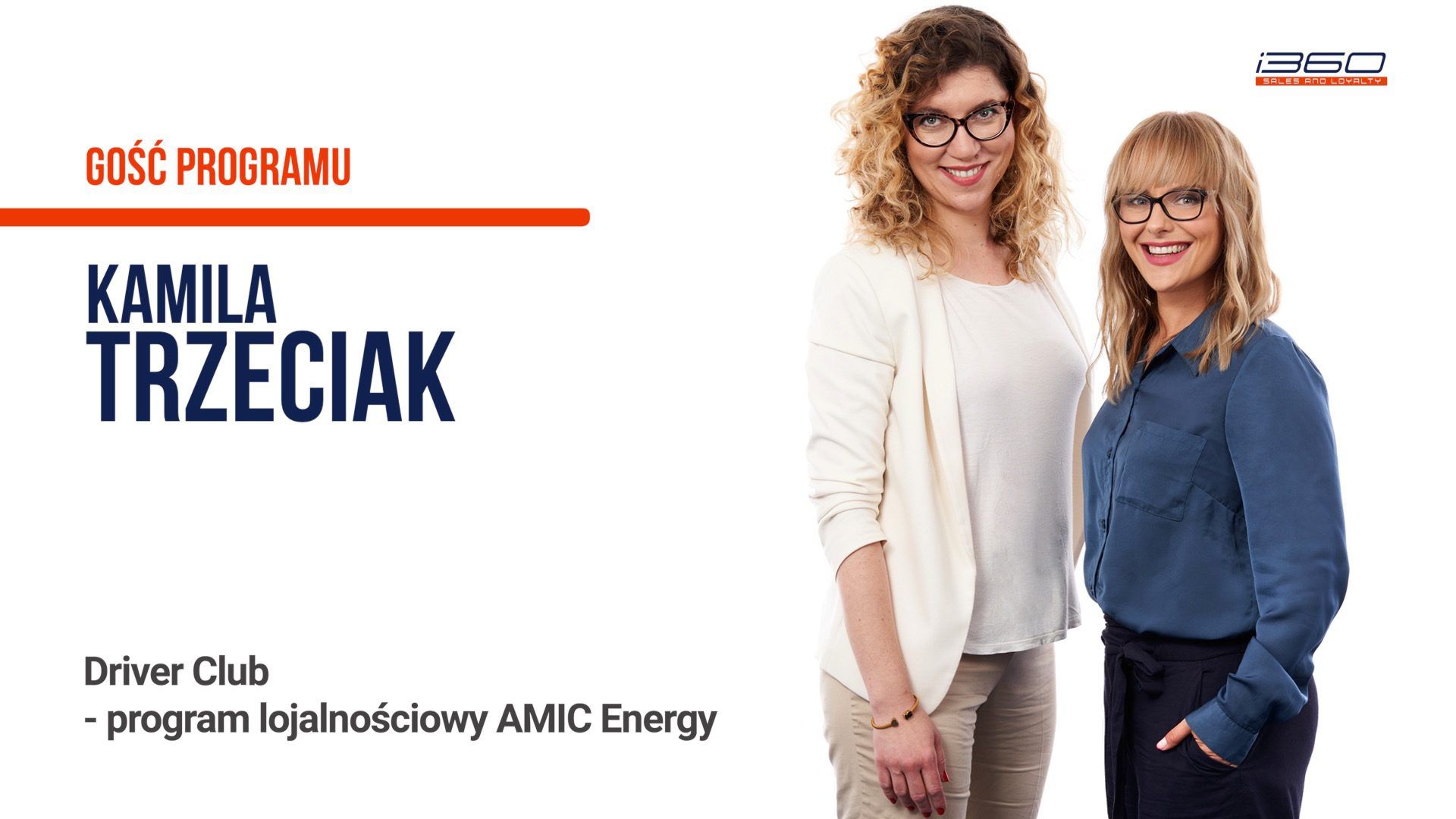
Petrol stations are a market segment that is highly saturated with loyalty schemes. Almost every operator in this sector has its own loyalty scheme or participates in multi-partner schemes. My guest today is someone with extensive experience in managing end-consumer loyalty – Kamila Trzeciak from AMIC Energy. Katarzyna Nawrocka, welcome to the programme „Loyalty Schemes by Night”. Good evening.
Good evening.
Kamilo, AMIC Energy is the newest brand amongst petrol stations on the national market, isn’t it?
Yes. The AMIC Energy brand has only been operating in Poland for three years and was established following the takeover by the Austrian fuel group Amic Energy of the Lukoil petrol stations that had previously been operating in Poland.
So you were formed as a result of a rebrand?
Yes. And as a result of this rebranding, not only have the stations themselves been modernised as buildings, but they have also gained a very modern food and drink area. And Subway restaurants are already operating in nearly half of our network. And here I must also mention that we are Subway’s largest franchisee in Poland, which is a source of immense pride for us.
I wanted to ask you about this rather unusual approach. I say ‘unusual’, but in a very positive sense, because the cornerstone of your company and your brand is, above all, friendly service. People and the quality of service. That’s quite unusual.
Yes, but it stems entirely from our company’s internal culture. Our sales staff build truly long-term relationships with customers. And this stems from the fact that, internally, within the company, we simply get on very well with one another, and this positive energy – which is genuinely based on mutual respect – then radiates outwards. And that’s why the sales staff at our stations adopt this approach. It simply stems naturally from our organisational culture.
So it wasn’t a strategy that had been devised from the very beginning?
It’s certainly a very coherent idea, but it wouldn’t have worked without people. Without staff who really take it very seriously.
Well, I can’t really ask you about your loyalty scheme here, because you were set up three years ago and launched your loyalty scheme as AMIC Energy. So how do you compete with such established players who’ve been in the market for many years and are your competitors?
Fantastic. Fantastic, because, in truth, creating something from scratch is, for me personally, a brilliant professional and business experience, but also, for the company, building something based on those values I mentioned earlier, on the need… Through the loyalty scheme, sharing this positive energy with customers is a brilliant experience. Let’s not forget that the oldest loyalty scheme run by a petrol station chain in Poland is celebrating its 20th anniversary this year. And Driver Club celebrated its second birthday a month ago. So what? Well, we’re making our mark – I think very positively – on the market. And it really is a very, very interesting and enjoyable professional and personal experience.
You’ve already revealed the name of your loyalty scheme. And you also mentioned that you celebrated your second anniversary – so, after about a year on the Polish market, you decided to launch a loyalty scheme.
Yes, it was a natural consequence of the approach and business strategy adopted by our owners and our brand. And thanks to that, Driver Club is growing; we’re now into our third year.
In that case, Kamilo, let’s talk about what your loyalty scheme involves and what sets it apart from other petrol stations.
Well, we’re the best.
You couldn’t have answered any other way.
But that’s a very, very honest answer. It’s not as if I’m saying this now just because I have to. No – what sets our programme apart, above all, is the very fast rate at which points – loyalty points – are earned. And what’s more, in the Driver Club, customers have a very wide range of options when it comes to choosing what to spend their points on. So they can use these points for rewards from the catalogue, for products at petrol stations, they can pay with these points, and they can also activate fuel discounts.
I wanted to ask you about another aspect, perhaps straying slightly from the main point, which is filling up with petrol at a petrol station, because these days we can find many other products at petrol stations. We can do our shopping, we can wash our cars, and very often these purchases have nothing to do with the car itself, let alone with fuel or car repairs. Sometimes it’s just grocery shopping. What kind of challenge does this pose for a petrol station owner? Well, because you have to stock a wider range of products, and that certainly presents a challenge.
I’ll go one step further – this is a challenge, but it’s actually an opportunity. And an opportunity, first and foremost, for growth, but also an opportunity to give our customers more ways to use and collect loyalty points. In other words: the more products – and fuel is, of course, a product too – but the more services such as catering and retail items, the more points customers can earn. So the more varied the range of services at a petrol station – in this case, a petrol station – the more opportunities there are for customers.
So it’s not a challenge, but an opportunity. And an opportunity for both you and your customers.
Yes, yes. We have a clear policy here to share this positive energy equally with our customers. Another very important aspect here is that, as we offer our customers a wider and more varied range of services and products, we can simply award them more bonus points on top of those earned when refuelling.
We live in the reality we live in. So, of course, I have to ask you: has the coronavirus pandemic had any impact on your members, the members of your loyalty schemes? Have you noticed any difference, or have you carried out any research?
Yes, well, the pandemic itself meant that customers in practically every sector said, „Enough is enough”. And of course, it seems to me that the fuel sector was the one most, or one of the most, affected by the pandemic, because we had a lockdown and people weren’t travelling. And that in itself… That moment highlighted the value of building customer loyalty. Our programme had been running for just under a year when the lockdown began and the pandemic took hold. And yet it showed that loyal customers – they do come back, they want to come back – but what’s more, they actually fill up more often than those who aren’t loyal. And here, I think Driver Club played a huge part in AMIC Energy closing the 2020 financial year with a profit, which, it seems to me, wasn’t was by no means a foregone conclusion, and I believe the Driver Club played a very significant part in this.
Well, congratulations are in order. I’d also like to ask you a bit more about the mobile app, as I suspect your loyalty scheme has one. Let’s talk about how it works.
The AMIC Energy PL app was launched after a year of the programme’s operation. And I must say that it holds a very special place in my professional heart. But first and foremost, whilst my heart is my heart, it turns out that our customers really needed it and value it highly. And this is also very measurable – the extent to which they value it – because I can simply see the number of active users of the app growing. And this is the channel – the channel of communication with the customer – which, in my opinion, is the only one, this digital channel, that has a real chance of retaining the customer’s attention at this moment in the most desirable way. It’s also the only one with potential for growth. In my view, it’s the only growing category of communication at the moment. So that’s the first point; and secondly, our app has several unique features, and the one that is certainly highly valued – and probably the most valued – amongst our customers is the price comparison tool, where we show prices at our stations and at our competitors’ stations. And here I can personally assure you that we really do attach great importance to the accuracy of this comparison. So these prices – the fuel prices in this comparison – are very, very carefully monitored and displayed. I personally use the navigation feature to find our stations very often, which is also available in our app. Whenever I travel outside Warsaw, where our office is based, I always fill up at AMIC Energy stations, and thanks to the app, I can find my way to our station as easily as possible.
You mention that more and more people are using the app. Well, yes, we all carry a mobile phone with us now, but not everyone uses theirs in the same way. Not everyone has a smartphone, so I wanted to ask you whether this means that, since your app was launched a year later, it was possible to collect points on a so-called plastic card for a year?
You could collect points on that plastic card you mentioned. However, of course, every account and every card has its counterpart in the Customer Portal on the website, so just as in the app, all the programme’s features can also be accessed via the website.
I’m actually more concerned about the participants who, for whatever reason, don’t want to use a smartphone and don’t have the app. Is this option still part of your programme?
That’s all, but I can’t go without mentioning my favourite customers – the elderly, who really don’t use smartphones, and we’ve actually managed on more than one occasion to assist such customers with a smile on their faces at our Customer Service Centre. And they are such lovely customers.
Kamilo, the profit margin on fuel is significantly lower than that on other products. Examples include windscreen washer fluid or simply food products. How do you deal with this challenge at Driver Club, and, above all, does it affect the loyalty scheme?
Yes. And I think this is very positive from the customer’s point of view, because we give customers significantly more points for these high-margin products. It’s also an opportunity for us to actually share with our customers what we’ve achieved together, so thanks to this diversified range, our customers simply earn more loyalty points. Consequently, they can earn them more quickly, accumulate the number of points required to claim a specific reward, and then redeem it.
Payment features are becoming increasingly common in petrol station mobile apps. What are your plans in this regard?
Yes. Well, I have to say that we monitor market trends and what our competitors are doing in great, great detail. And there’s no denying that development – the development of apps, the development of this trend – is, in a way, a necessity. We have to keep up – just like any other company, in fact; Driver Club and AMIC must also follow these market trends in order to continually strengthen our competitive position.
So let’s find out what factors you take into account when selecting prizes for the prize catalogue.
Prizes catalogue.
This is of interest to everyone!
I love it. Yes, I think there are two key trends here: seasonality and the regular rewards for which customers collect points.
So you’re telling us that nobody will be interested in a hammock in December?
Well, not in December, but right now our garden range is proving very popular with us. It’s very, very important to adapt flexibly to the customer’s needs. That means taking into account seasonality, the festive season, and various important occasions in our customers’ lives. This is a very, very strong pillar. On the other hand, there are customers who collect points towards a specific reward they’ve set their sights on in the permanent catalogue. And this, in turn, creates certain requirements: firstly, the offer must be attractive to the customer. So these are well-known product brands. It must be priced appropriately – in other words, it simply has to be good value for money for the customer – cheap, to put it bluntly. And this is where the pace of collecting points, which I mentioned earlier, is crucial. With us, customers collect points faster than in rival programmes. That’s why this catalogue is truly my pride and joy. I fine-tune it practically every day, because building this diversified range for customers is absolutely vital – our customers simply collect points very quickly, so they have the opportunity to use them both on those seasonal products I mentioned earlier and on the permanent items in the catalogue, for which I know it takes them a little longer to save up their points.
Are these rewards – the ones that are permanently listed in the catalogue – usually, I don’t quite know how to put it, ‘big’ rewards that take longer to earn? Do we need more points?
Yes, it’s true that steam mops, for example, are hugely popular. These are also products with a range of unit prices. Here, I always try to cater to all customers when setting the price. So we have a lower-price range, a mid-price range and a higher-price range. It’s all presented clearly to the customer: well-known brands, but at different prices.
And so, just as the reward marks the end – in inverted commas – of our involvement, at least for the time being, in the loyalty scheme, we’re drawing to the end of the episode. But I have one more question. I wanted to ask you what your plans are for the future development of Driver Club?
We must constantly learn to anticipate our customers’ needs. And this isn’t just PR rhetoric, because these are elements that are clearly measurable in economic analysis and in Business Intelligence – they are clearly measurable factors. So learning to do this – I’d even go so far as to say anticipating these needs – is what’s essential for growth. The IT aspect is certainly crucial. I mean, the whole IT infrastructure ensures the smooth running of all loyalty programmes – not just ours, of course – but here too we must always be one step ahead so that customers do not experience any problems or system failures. These IT elements are absolutely vital. And the final element, which is also very important, is learning about – and constantly applying – this knowledge of consumer behaviour and customer psychology. This is constantly changing, because our world is in a state of flux, and the needs customers had a year and a half or two years ago are a completely different world compared to what we have now. And in the same way, in two years’ time, that customer will also be completely different, so all three of these elements – business intelligence, IT and customer psychology – are closely interlinked and highly interdependent; so, in reality, Driver Club’s development will be based on these three pillars.
I’d like to wish you all the best, not just for the next three years, but in general. And thank you very much for an interesting and lively conversation.
Thank you, Kasia.
That’s all for now, and I look forward to seeing you in the next episode.